Resources & Tools
Interactive POCUS tools, plus protocol guides, reference cards, worksheets, and research papers
What needs an account?
Most EASy learning content is open to view. A free account is required for downloadable resources so we can measure their educational use — it takes a minute and needs no code. Member access adds the modules, the bedside tools, the full scenario library and training progress; today it is activated with an EASy workshop invitation code, and progress is tracked with the course group that code belongs to.
| Resource | Access |
|---|---|
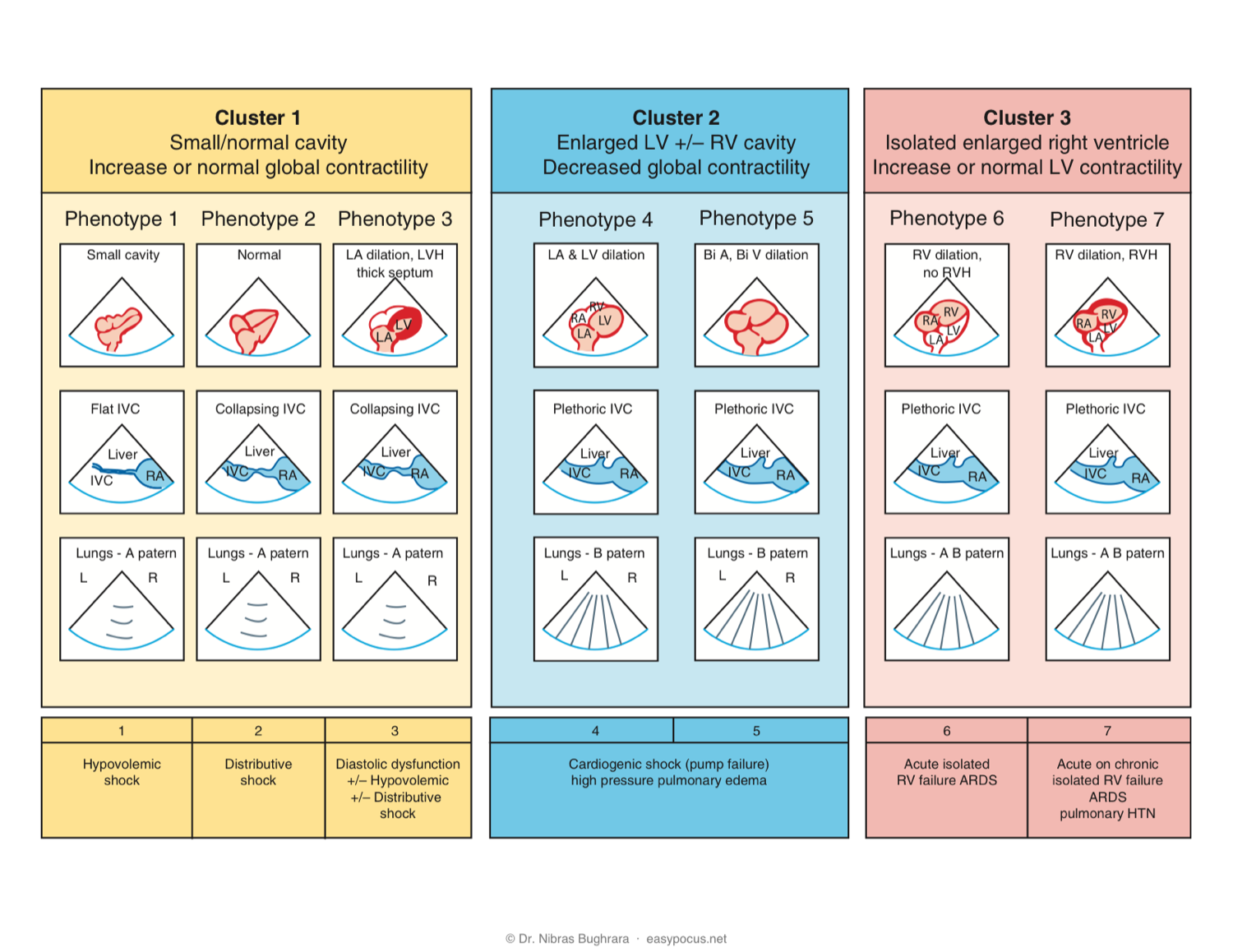
| Protocol pages and the phenotype chart | Open |
| Acquisition-card web pages | Open |
| Introductory phenotype drill & the weekly scenario | Open |
| Downloadable cards, guides and PDFs | Free account |
| Upload subcostal clips for educational review | Free account |
| Submit a teaching scenario for review | Free account |
| Bedside tools (MAP, Sepsis, PDA, ALS) | Member access |
| Modules and the full scenario library | Member access |
| Portfolio and competency tracking | Member access |
Educational resources require a free account; public conference programmes and external registration materials stay open. No invitation yet? Course directors issue them — see the upcoming workshops, or get in touch about training your institution.
Bedside tools
Member accessEASy MAP Tool
The core EASy exam for undifferentiated hypotension. Score the cardiac view on the 12-point scale, read heart–IVC–lung–pleura, and classify into one of ten hemodynamic phenotypes with etiology and management.
EASy Sepsis Tool
POCUS-guided septic-shock resuscitation. Enter heart, IVC, and lung findings to identify the hemodynamic phenotype and see the educational considerations associated with it.
EASy PDA Tool
Pre-induction phenotyping for the physiologically difficult airway. Heart, IVC, lung, and gastric findings → the educational pre-induction considerations associated with the pattern.
EASy ALS Tool
Intra-arrest guidance with the ACLS code toolkit built in — pulse-check & epinephrine timers, drug/defibrillation reference, the Hs & Ts, and true vs pseudo-PEA with reversible causes.
EASy bedside cards
Print-ready phenotype recognition and resuscitation cards — five double-sided cards built for the bedside and your ultrasound machines.
Get the cards →EASy MAP — companion course
The protocol as a self-study book: the method, machine setup and the six views, reading each window, image quality, the ten phenotypes with their management and traps, the differential, and the evidence with its limits — plus a four-week plan and questions to check yourself. Read it on your own, then use the site for the clips, drills and tools.
Download the PDF →Research Papers
Book chapter — Focused Point-of-Care Ultrasound in Cardiac Arrest
Bughrara N, Hsu W, Cha S, Pustavoitau A. In: Comprehensive Critical Care Ultrasound, 3rd ed. Society of Critical Care Medicine (forthcoming, 2027). The chapter the EASy-ALS lessons are built on: the EASY-ALS protocol table, the arrest algorithm, and the four pseudo-PEA patterns. Link opens SCCM's companion media for the edition.